
A simple guide to running a What? So What? Now What? retrospective
06 December 2025
This technique is usually the first format I consider for a retrospective. I do that because it:
- makes good use of the ‘ORID’ facilitation structure (Objective, Reflective, Interpretive, Decisional)
- stops people jumping to solutions that aren’t important
- flattens out the power dynamics in a team and involves everyone
- easy to teach, and teams tend to pick it up quickly. You’ll soon see them using it in all sorts of situations
- works for a quick five-minute check-in or a full session with a big group
- helps teams reliably make and agree on decisions
What to do before
Preparation is essential for any retrospective.
Step 1: Write your invitation question
This is the leading question you will use at the beginning of the session to invite discussion.
Keep it specific and focused on a real event such as a sprint, an incident, or a conflict.
Example:

"Given we had a system outage yesterday, what can we learn from it?"

"What can we learn about releasing this new feature?"

"Last week we couldn't decide whether to choose option A or option B, and that caused us a delay. How can we better work together?"
Step 2: Choose the right tools and timings
Think about the environment you want to create. Include timings, tools, and any variations that fit directly with how your team works.
Decide if you need to use 1-2-4-All. With smaller groups you can keep things simpler and skip using it, but if you have a group of 8 or more, I recommend it.
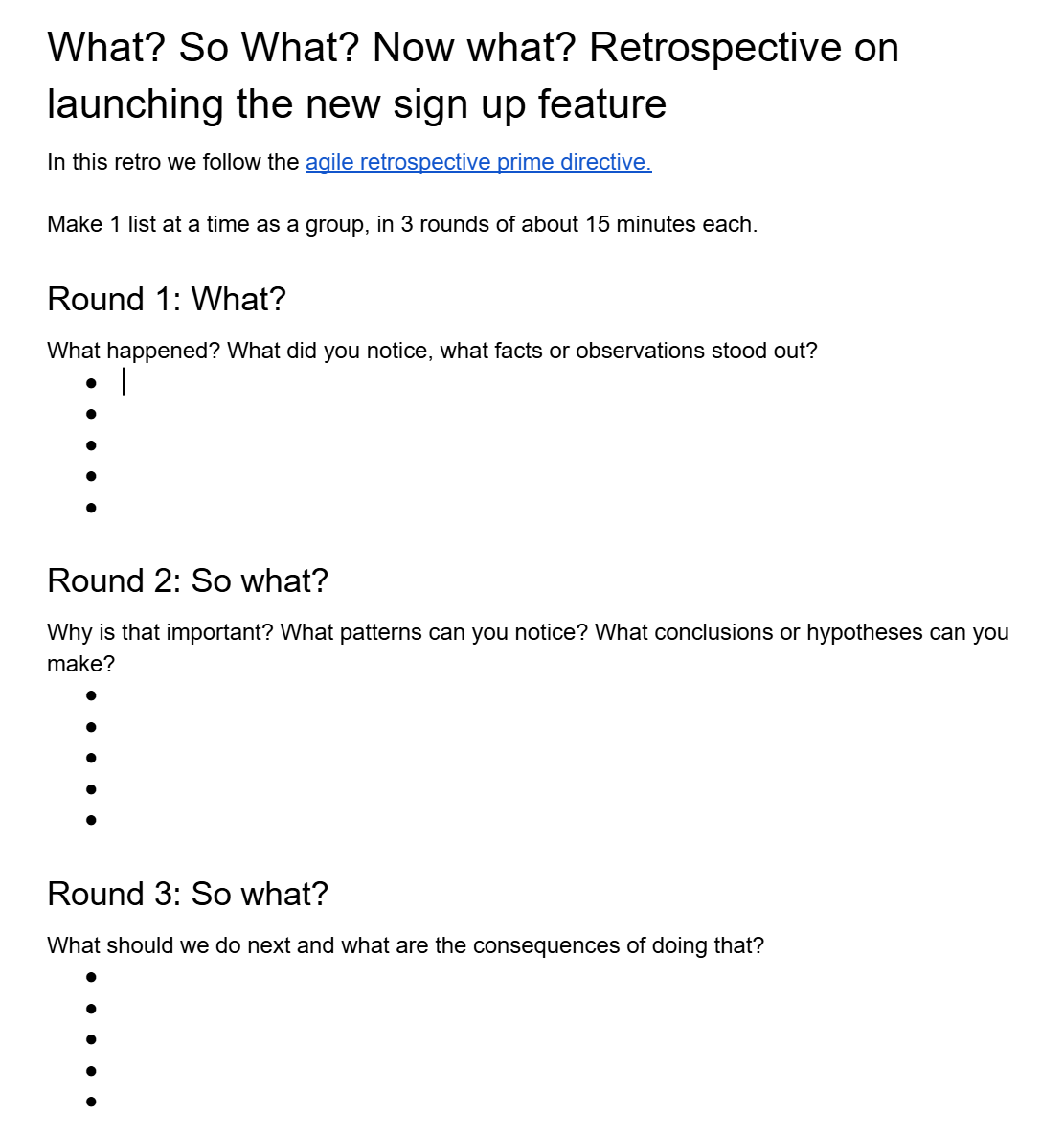
Step 3: Prepare a worksheet
If you’re not using 1-2-4-All, edit the worksheet with your invitation question.
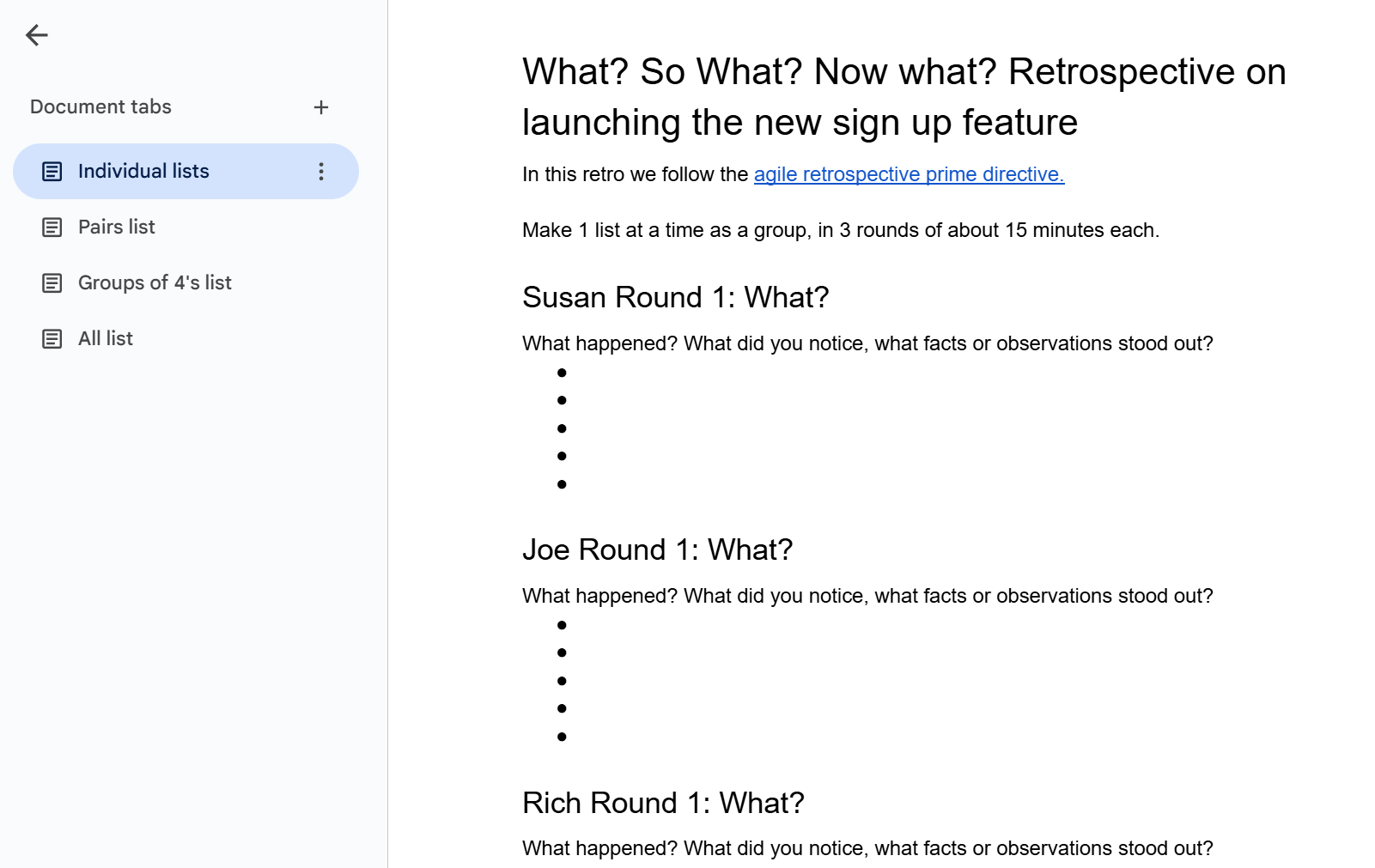
If you are using 1-2-4-All then make extra space for:
- everyone to have their own list
- each pair to have their own list
- each group of 4 to have their own list
- there to be 1 final list that all of the lists get refined into
Don’t worry about having lots of blank lists. 1-2-4-All is fast-moving, and you’ll create, combine, and replace lists quickly.
Screenshots of how to prepare your template
Step 4: Send out your calendar invite
Link the worksheet in your calendar invite as early as possible. It will tell attendees what to expect.
Remember that not everyone does their best thinking on the spot, and being open about your format and questions in advance of the session is respectful of the diverse nature of thinking that happens in your team.
Describe the session structure in your invite. If you’ve not done it with the team before, you can edit this invite text:
Meeting title: Retrospective on [subject of reflection]
Description: 45 minutes for the team to reflect on [subject] that has happened in [a time frame].

I’ll kick things off by asking [invitation question]

You don’t need to prepare beforehand. You’re welcome to add to the What section early, but please leave the rest blank.

In the session we will:

* step 1: Gather facts and observations (about 15 minutes)
* step 2: Analyse what were the effects of these things in that first list, and why that is important to us (about 15 minutes)
* step 3: Decide what to change about how we work and who is responsible for making sure it happens (about 15 minutes)
What to do during
Start with the Agile Prime Directive.
Step 1: Set out the objective
Clearly set out your invitation question, and check for any clarification questions. There might be clarifying questions about time frames or the scope of the conversation ahead.
Step 2: Explain the structure
Explain that decisions will come later, but we’ll think in a structured way to reach them.
You’ll have three rounds. Start with the facts in round 1. In round 2 think about what matters about those facts, and only then in round 3 will you decide what to do next.
Step 3: Run the What list ideation
Fill in the What list, keeping people strictly focused on facts and observations.
If you’re using 1-2-4-All, ask people to find their own What list in the worksheet. Then combine lists when in pairs and when in the group of 4. In the ‘all phase’ populate the main worksheet in a round robin, with each team removing duplicates as they go.
Each pairing refines the list in detail, depth, and focus.
Step 4: Run the So What list ideation
Ask people to think of a fact in the What list that they are drawn to most, and then analyse it. Why does it matter? What patterns or conclusions can we draw from it?
Make a new set of So What lists only with those observations.
Use the same structure as before if using 1-2-4-All to make short-lived lists that eventually merge into one collective So What list.
Step 5: Run the Now What list ideation
Ask people to choose something from the So What list and decide what they want to do about it. A helpful guiding question is: “Which of these actions will make the biggest difference?
If using 1-2-4-All repeat what you’ve done before to generate your ‘all’ list.
When you have your list of actions, now is the best time to prioritise them.
What to do after
Follow up on actions in your regular team rhythms so nothing is forgotten. Small, consistent follow-up is what turns insights into change.